How to Choose Reliable Non Woven Fabric Manufacturers?
Choosing reliable non woven fabric manufacturers is not simply a matter of comparing prices. The right partner must consistently deliver suitable materials, stable quality, and clear technical support. A fabric roll may look acceptable under warehouse lighting, yet fail during lamination, filtration, packaging, or medical production. Small differences in fiber blend, basis weight, tensile strength, and moisture control can create costly problems later.
Practical evaluation begins with evidence. Request recent product samples, test reports, factory photographs, and details about raw material sources. Ask how production teams control web formation, bonding temperature, thickness, and roll winding. A trustworthy manufacturer should explain these processes in plain language. Certifications can support credibility, but they should never replace independent verification. Check whether documents match the actual factory and product. No checklist is perfect.
Site visits, video audits, and trial orders reveal details that brochures often hide. Look for clean storage areas, labeled batches, calibrated testing equipment, and workers who understand inspection procedures. Discuss minimum order quantities, lead times, packaging, defect handling, and communication during delays. My experience suggests that honest limitations are often more valuable than impressive promises. A supplier that admits capacity constraints may be safer than one guaranteeing everything immediately. Still, personal judgment can be biased. Use measurable criteria, written specifications, and repeat testing before making a long-term decision. Reliability grows through consistent results, not persuasive sales language.
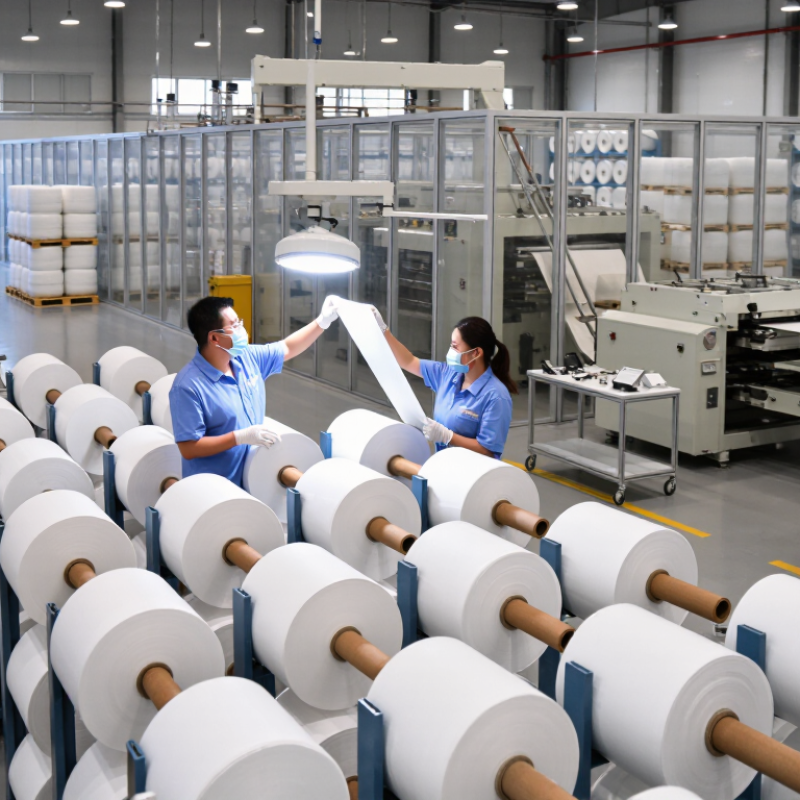
Define Your Non Woven Fabric Requirements and Quality Standards
Before comparing non woven fabric manufacturers, write a measurable specification sheet. Define fiber type, basis weight, thickness, width, color, bonding method, and roll length. State the intended use clearly. A face mask, filtration layer, and agricultural cover require different performance targets.
Set numerical limits for tensile strength, tear resistance, air permeability, absorbency, and shrinkage. Use ISO 9073 methods where applicable, or the relevant ASTM and EN methods. EDANA’s 2023 European statistics reported approximately 3.1 million tonnes of nonwovens production. That scale makes consistency more important than attractive samples. Request test reports from independent laboratories, not only factory data. Check sample-to-sample variation.
Ask for lot traceability, raw-material records, and retained samples. Smithers’ The Future of Nonwovens to 2029 highlights continued demand from hygiene, medical, filtration, and construction applications. Each application needs separate acceptance criteria. For example, a filtration fabric should specify pressure drop and particle efficiency. A medical material may require cleanliness, microbial control, and sterilization compatibility.
Do not trust “premium quality” alone. It is vague. A practical factory audit should compare three production lots, not one perfect roll. Inspect edge alignment, winding tension, visible contamination, and moisture levels. I have seen specifications fail because the buyer measured thickness differently from the supplier. That mistake is easy to miss. Define every test condition, sampling frequency, and rejection limit before purchasing. Some requirements may still be unrealistic. Revise them after pilot production.
How to Choose Reliable Non Woven Fabric Manufacturers? - Define Your Non Woven Fabric Requirements and Quality Standards
| Requirement Area | Typical Product Requirement | Recommended Quality Target | Suggested Verification Method | Why It Matters When Selecting a Manufacturer |
|---|---|---|---|---|
| End Use | Packaging, hygiene products, medical disposables, filtration, agriculture, construction, or automotive applications | The fabric structure, polymer, weight, strength, and surface treatment should be matched to the intended use | Review the technical specification sheet and approve a production sample for the actual application | A manufacturer should recommend a suitable process, such as spunbond, meltblown, spunlace, needle-punched, or composite construction |
| Fiber and Polymer Type | Polypropylene, polyester, viscose, polyethylene, polyamide, or blended fibers | Material identity and blend ratio should remain within the agreed specification, commonly within a tolerance of ±2 percentage points for declared blends | Supplier declaration, incoming-material records, and independent polymer or fiber composition testing when required | Material consistency affects strength, softness, chemical resistance, thermal performance, and product safety |
| Basis Weight | Lightweight grades of approximately 12–40 g/m²; medium grades of 40–100 g/m²; heavy grades above 100 g/m² | Set a nominal value and tolerance, such as 25 g/m² ±5% or another range appropriate to the product design | Measure mass per unit area according to ISO 9073-1 or an equivalent recognized method | Uneven basis weight can cause weak spots, inconsistent coverage, poor absorbency, and unstable converting performance |
| Thickness and Bulk | Often approximately 0.10–2.00 mm, depending on fiber type, bonding method, and basis weight | Define thickness tolerance and the test pressure because compression changes measured values | Measure according to ISO 9073-2 or an equivalent standard under controlled pressure | Thickness influences cushioning, filtration depth, liquid holding capacity, drape, and roll length |
| Tensile Strength | Specify machine direction and cross direction performance; lightweight materials may require approximately 20–80 N/50 mm, while heavier products may require higher values | Set separate minimum values for MD and CD and define the acceptable directional ratio | Test peak tensile strength according to ISO 9073-3 or ASTM D5035, as applicable | Adequate strength reduces tearing during slitting, sewing, thermoforming, filling, and final use |
| Elongation | Common values range from approximately 20% to more than 100%, depending on the process and fiber structure | Define minimum and maximum elongation where dimensional stability or stretchability is important | Measure elongation together with tensile strength using ISO 9073-3 or an equivalent method | The correct elongation range helps prevent distortion, wrinkling, cracking, and poor fit in converted products |
| Air Permeability | Breathable hygiene and medical materials may require approximately 50–300 L/m²/s; filtration media generally require a controlled balance between airflow and efficiency | Specify the target value, test pressure, and acceptable tolerance rather than evaluating breathability by touch alone | Test according to ISO 9073-15 or ASTM D737, with the pressure stated in the report | Air permeability affects comfort, drying speed, pressure drop, ventilation, and filtration performance |
| Liquid Resistance | Water-repellent covers may require a specified spray rating; barrier materials may require hydrostatic pressure or liquid strike-through limits | Set a minimum hydrostatic pressure or liquid-barrier classification appropriate to the end use | Use ISO 811 for hydrostatic pressure, ISO 4920 for surface wetting, or the relevant product standard | A reliable manufacturer must control coating, lamination, pore structure, and treatment uniformity across the full roll |
| Filtration Performance | Define particle size, test aerosol, airflow, efficiency, and pressure drop for air or liquid filtration applications | Use application-specific limits; for example, medical face-mask materials may require bacterial filtration efficiency, differential pressure, and splash-resistance testing | Test under the applicable standard, such as EN 14683, ASTM F2100, or a designated filtration-media method | Filtration results cannot be confirmed by basis weight alone; process control and laboratory testing are essential |
| Surface Appearance | Uniform color, texture, pore structure, and bonding pattern across the complete roll | No holes, tears, hard spots, delamination, oil marks, foreign particles, excessive lint, or visible streaks; define defect limits in writing | 100% online visual inspection supported by documented sampling and roll inspection records | Visible defects often indicate unstable web formation, contamination, poor bonding, or inadequate process monitoring |
| Roll Dimensions | Specify finished width, roll length or weight, core inside diameter, outer diameter, winding direction, and splice requirements | Typical width tolerance may be set around ±1–3 mm, subject to equipment capability and product requirements | Measure width, core, roll length or weight, and winding quality for every defined inspection lot | Accurate roll dimensions improve machine efficiency and reduce waste during downstream converting |
| Color and Colorfastness | White, natural, or custom-colored fabric with an approved physical or digital color reference | Define color difference tolerance, light exposure requirements, and resistance to rubbing, washing, or chemicals where relevant | Use instrumental color measurement and applicable colorfastness methods, such as ISO 105 series tests | Documented color control prevents batch-to-batch variation and customer rejection |
| Chemical and Product Safety | Requirements may include low odor, restricted substances, skin-contact safety, biocompatibility, or food-contact compliance | The supplier should provide current declarations and test reports for the destination market and intended use | Review safety data, restricted-substance testing, migration testing, or biological evaluation when applicable | Compliance responsibility depends on the product, market, and contact conditions; a generic certificate is not sufficient |
| Quality Management | Controlled raw-material purchasing, production monitoring, laboratory testing, nonconformance handling, and corrective action | A documented quality system, traceable batch records, calibrated instruments, and defined inspection plans | Request audit evidence, calibration records, certificates, inspection reports, and sample traceability | Reliable systems reduce variation and make it possible to identify and correct problems quickly |
| Pre-Shipment Acceptance | Inspection of appearance, dimensions, basis weight, strength, packaging, labeling, and required performance properties | Approve a written quality agreement containing specifications, sampling levels, defect definitions, and corrective-action requirements | Use an agreed inspection plan based on ISO 2859-1 or another suitable sampling procedure | Clear acceptance criteria prevent disputes and ensure that production meets the approved sample and specification |
Note: Target values should be finalized according to the product design, regulatory market, converting equipment, and applicable product standards. Test conditions and acceptance tolerances should always be stated in the purchasing specification.
Related Posts
-

How to Choose the Best Non Woven Fabric for Your Projects
-
Top Non Woven Supplier in China?
-

What Are the 2026 Top Types of Non Woven Material?
-

Why Non Woven Fabric Manufacturers Are Key to Sustainable Industry Solutions
-

How to Choose the Best Non Woven Fabric for Your Projects
-

Why Non Woven Fabric is Revolutionizing Industries and Everyday Products